


Navigating Washington State’s Clean Buildings Performance Standard
Washington State’s Clean Buildings Performance Standard (CBPS) is one of the most significant energy efficiency mandates for commercial real estate in the country. If you own or manage buildings larger than 20,000 square feet in Washington, you’re subject to this regulation—and compliance deadlines could be as soon as six months away.
The path to compliance is complex, but it doesn’t have to be a burden. With the right approach, meeting CBPS requirements can reduce energy waste, create immediate cost savings, and position your portfolio for long-term competitiveness.
What Is the Clean Buildings Performance Standard?
CBPS requires commercial buildings to meet Energy Use Intensity targets (EUIt), which measure energy consumption per square foot based on building type. The targets are aggressive: buildings must reduce energy consumption to 15% below the median for similar building types. The regulation is administered by the Washington State Department of Commerce under WAC 194-50 and ASHRAE Standard 100-2018.
The penalty structure is designed to drive action with penalties of $1 per square foot plus $5,000. Initial penalties start at $5,000 and escalate based on days of non-compliance and building size. Owners with several non-compliant buildings can expect fines exceeding $1 million annually. Beyond direct penalties, non-compliant buildings face reputational risk and impacts on property valuations—factors that increasingly matter to tenants and investors.
Understanding the Compliance Tiers
CBPS divides buildings into two tiers based on size, with different requirements and deadlines for each.
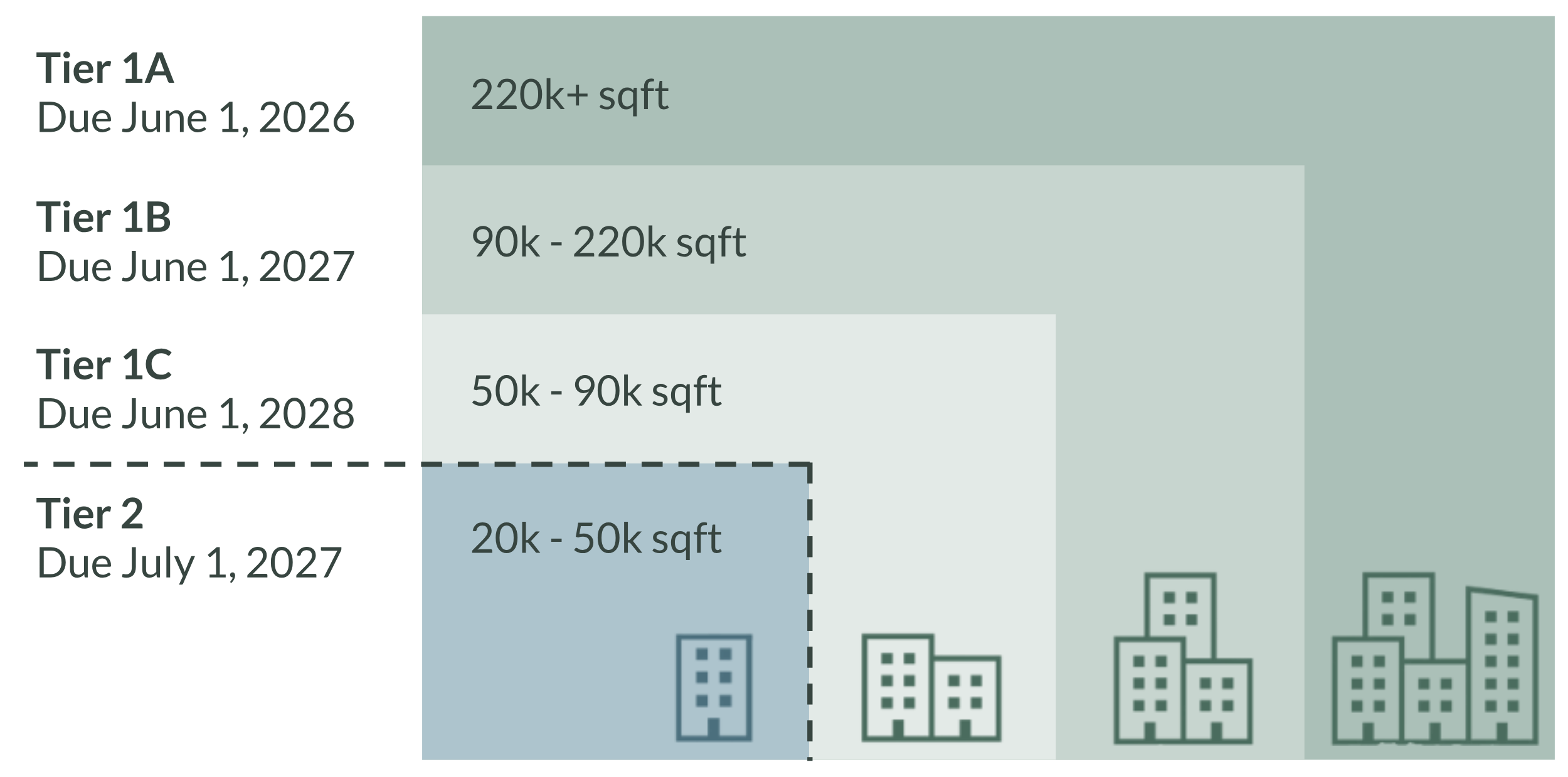
Tier 1 covers commercial buildings over 50,000 square feet. These buildings must meet EUIt targets, implement an Energy Management Plan (EMP), and maintain an Operations & Maintenance (O&M) program. Compliance deadlines are staggered by building size:
Tier 2 covers buildings between 20,000 and 50,000 square feet, as well as all multifamily residential buildings over 20,000 square feet. Tier 2 buildings must complete benchmarking, develop an EMP, and implement an O&M program—though they are not yet required to meet a specific EUIt target. The compliance deadline for all Tier 2 buildings is July 1, 2027.
Why Building Owners Need to Start Now
If your building is larger than 90,000 square feet, your compliance deadline is June 2027—roughly 18 months away. That may sound like plenty of time, but the legislation requires submission of 12 months of compliant data and may necessitate capital expenditures for corrective actions.
Additionally, your O&M program must be implemented 12 months before your compliance date. That means for a June 2027 deadline, your O&M program needs to be operational by June 2026—approximately six months from now. You’ll also need 12 months of compliant operational data and a completed Energy Management Plan before you can submit for compliance.
Tier 1 buildings that don’t meet their EUI targets must conduct an ASHRAE L2 energy audit and identify efficiency measures, which often require capital investment. These projects take time to plan, fund, and execute—adding further pressure to an already tight timeline.
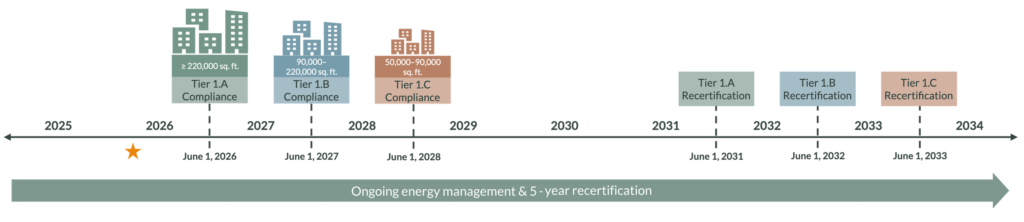
While we recommend owners begin at least two years before their deadline, we can help you navigate a compressed timeline if necessary.
Turning Compliance Into an Opportunity
For most building owners, CBPS feels like a burden—another regulatory hurdle requiring time, money, and attention. That reaction is understandable. But the owners who approach this strategically often find something different: the compliance process reveals waste they didn’t know existed and creates savings that fund further improvements.
This is the approach we take at Olympic Sustainability Group. We apply energy efficiency and sustainability concepts to concrete business cases to reduce energy waste and create immediate, net-positive savings. Those savings can be reinvested to develop sustainability ecosystems that continue driving energy costs down over time.
Energy inefficiency is often treated as the “cost of doing business.” Energy waste is rampant in large commercial buildings, but it’s hard to pinpoint and control—especially for property management teams already stretched thin. Our job is to find that waste and eliminate it.
A typical engagement follows a structured process: compliance assessment, utility analysis, building systems analysis, stakeholder coordination, strategy development, and capital expenditure planning. Successful engagements rely on data transparency, broad scope, and leadership access. These conditions allow for “quick wins” that build momentum to fund long-term value.
What This Looks Like in Practice
We recently worked with the owner of a 1.8 million square foot enclosed shopping center facing CBPS compliance. We guided them through establishing baseline performance, understanding their metering complexities, and documenting their energy and building management practices.
Through this process, we identified that the property lacked a unified system for tracking equipment, documenting required procedures, and meeting CBPS requirements. Rather than creating parallel tracking systems, we developed equipment inventories around their existing workflows. We drafted O&M protocols that reflect how their teams actually operate, and we collaborated with site staff to ensure compliance documentation serves as a practical tool—not just paperwork that collects dust.
In parallel, we developed a long-term energy action plan for capital planning and strategic energy reduction. The identified efficiency measures—including HVAC replacements, strategic energy management, and lighting retrofits—are projected to save 3,400 MWh of electricity and 15,000 therms of natural gas annually, representing approximately $300,000 in reduced annual OPEX spending.
We integrated this roadmap into the building’s EMP, O&M documentation, and equipment inventories. The result: the building met its compliance requirements, and the owner gained a clear path for future investment, with savings that offset implementation costs.
Working with Olympic Sustainability Group
We blend engineering expertise with collaborative interpersonal skills to effect change—working alongside your property management teams rather than around them.
We don’t just stop at compliance. We work with owners to strengthen energy management practices that reduce costs and improve operations long after the deadline passes.
Whether you manage a single building or a multi-property portfolio, we can help you develop a compliance strategy that meets CBPS requirements and improves your building’s long-term performance and value.
Get Started
If you need to achieve CBPS compliance, we can help. Reach out to us at info@olympicsustainability.com
Olympic Sustainability Group is a sustainability consulting firm providing energy consulting, legislative compliance, and strategic planning services to real estate portfolio owners across the US.